

Kwanzaa meaning is simple: it is a week long celebration of African American culture, heritage, and community. It runs every year from December 26 to January 1, and each of its seven days honors one of seven principles. The name comes from a Swahili phrase that means first fruits of the harvest. In 2026, Kwanzaa begins on Saturday, December 26, and ends on Friday, January 1, 2027. It starts the day after Christmas Day. It shares the season with Boxing Day and New Year's Eve, but it is a holiday of its own, with its own history, symbols, and meaning.
If you have ever seen a kinara with seven candles, or heard someone say Habari Gani in late December, you have met Kwanzaa. Many people know the name, but far fewer know what it means, where it came from, or how it is kept. This guide explains it all in plain words: the meaning of the name, the seven principles, the 2026 dates, the symbols, the colors, and how Kwanzaa differs from Christmas. You will also find a short guide to the greeting, the feast, and the gifts, so you can follow the week with confidence.
Kwanzaa Meaning in Simple Words
Kwanzaa meaning is a celebration of African heritage, unity, and culture, kept for seven days at the end of each year. It is a cultural holiday, not a religious one, and people of many faiths keep it beside their own holidays. Families and communities gather each night to light a candle, share a meal, and reflect on one principle for that day.
The heart of Kwanzaa is the Nguzo Saba, the seven principles. The Swahili name means seven principles, and each one names a value that holds a community together. The seven are unity, self determination, collective work and responsibility, cooperative economics, purpose, creativity, and faith. One principle is honored on each day of the week, in that order, from December 26 to January 1.
Kwanzaa is observed by African Americans and by parts of the African diaspora in other nations of the Americas. A 2009 estimate put the number of Americans who celebrate Kwanzaa at between 500,000 and 2,000,000. The holiday is still young by the standards of old festivals, and in 2026 it marks its 60th year.
Where Does the Word Kwanzaa Come From?
The word Kwanzaa comes from the Swahili phrase matunda ya kwanza, which means first fruits of the harvest. Swahili is a language of East Africa, and its choice was a sign of Pan African pride. The holiday was built on the model of first fruits festivals in Africa, where the first crops of the harvest are gathered and shared with thanks.
There is one small twist in the spelling. The Swahili word for first is kwanza, with one a at the end. The founder added an extra a, so the name has seven letters, one for each of the seven principles. That is why the holiday is spelled Kwanzaa, not Kwanza.
The name is said KWAHN-zuh. The first part rhymes with swan, and the second part is a soft zuh. If you are not sure how to say it, the simple guide KWAHN-zuh will carry you through.
When Is Kwanzaa in 2026?
Kwanzaa 2026 begins on Saturday, December 26, 2026, and ends on Friday, January 1, 2027. The dates never move. Every year, Kwanzaa runs from December 26 to January 1, so only the days of the week change. The week lasts seven nights, and one candle is lit each evening.
The big feast of the week, called the Karamu, falls on Thursday, December 31, 2026, the sixth day. Families and friends gather in bright African style clothing for a large shared meal, with music, dance, and song. The last night, January 1, is the day of faith, and gifts are often given then.
Here is the full week for 2026, with one principle for each day:
- Saturday, December 26: Umoja, unity
- Sunday, December 27: Kujichagulia, self determination
- Monday, December 28: Ujima, collective work and responsibility
- Tuesday, December 29: Ujamaa, cooperative economics
- Wednesday, December 30: Nia, purpose
- Thursday, December 31: Kuumba, creativity, and the Karamu feast
- Friday, January 1: Imani, faith
Because the dates are fixed, it is easy to plan around them. If you are invited to a Kwanzaa gathering, the date will tell you which principle the evening honors. The greeting for the night is the name of that principle, so a quick look at the list above is all the preparation you need.
How Did Kwanzaa Begin?
Kwanzaa was created by Maulana Karenga, an activist and scholar, and it was first celebrated in 1966. Karenga created it in the year after the Watts rebellion of 1965, when a historic uprising shook the Watts neighborhood of Los Angeles, California. In the weeks after the rebellion, Karenga founded the Us Organization. Its aim was to rebuild the neighborhood and to promote a Black cultural revolution, one that would inspire pride in Black history and achievement.
His goal was to give African Americans a holiday of their own, one that honored their African roots and reaffirmed their cultural ties. The holiday drew on first fruits festivals from many parts of Africa, in the west, the east, and the southeast. It was the first holiday made just for African Americans, and it grew out of the Black Power movement of the 1960s.
In the early years, Karenga said Kwanzaa was meant as an alternative to Christmas. As the holiday gained wider support, he changed that position. In his 1997 book, Kwanzaa: A Celebration of Family, Community, and Culture, he wrote that Kwanzaa was not created to give people an alternative to their own religion or religious holiday. Today, many people who keep Kwanzaa also celebrate Christmas, and the two holidays sit side by side in the same season.
The seven principles were worked out in 1965, a year before the first Kwanzaa. Together they form Kawaida, a Swahili word that means tradition and reason. Karenga called the principles a communitarian African philosophy, the best of African thought and practice in constant exchange with the world.
The Seven Principles of Kwanzaa
The Nguzo Saba, the seven principles, are the heart of Kwanzaa. Each day of the week is set aside for one principle, and a candle is lit for it each night. The order is fixed, and it runs from unity on the first night to faith on the last. Here is what each principle means, in the order it is honored.
1. Umoja, Unity, December 26
Umoja means unity. The full idea is to strive for and to maintain unity in the family, community, nation, and race. It is the first principle because unity comes first. Before a community can build or create, its people must stand together. The black candle in the center of the kinara stands for Umoja, and it is lit on the first night.
2. Kujichagulia, Self Determination, December 27
Kujichagulia means self determination. The full idea is to define ourselves, name ourselves, create for ourselves, and speak for ourselves. It is about a people telling their own story in their own words, instead of letting others define them. A red candle is lit for this principle on the second night.
3. Ujima, Collective Work and Responsibility, December 28
Ujima means collective work and responsibility. The full idea is to build and maintain our community together, and to make our brothers and sisters problems our problems, and to solve them together. No one is left to face trouble alone. A green candle is lit for this principle on the third night.
4. Ujamaa, Cooperative Economics, December 29
Ujamaa means cooperative economics. The full idea is to build and maintain our own stores, shops, and other businesses, and to profit from them together. The point is practical: money spent inside the community stays inside the community and helps it grow. A red candle is lit for this principle on the fourth night.
5. Nia, Purpose, December 30
Nia means purpose. The full idea is to make the building and development of our community our collective purpose, and to restore our people to their traditional greatness. It asks each person to live with a goal that serves more than just the self. A green candle is lit for this principle on the fifth night.
6. Kuumba, Creativity, December 31
Kuumba means creativity. The full idea is to leave our community more beautiful and beneficial than we found it, doing as much as we can in the way we can. It is the principle of making things better, through art, craft, music, and care. A red candle is lit for this principle on the sixth night, the night of the Karamu feast.
7. Imani, Faith, January 1
Imani means faith. The full idea is to believe with all our hearts in our people, our parents, our teachers, our leaders, and the righteousness and victory of our struggle. It is the closing principle, and it looks ahead with hope. A green candle is lit for this principle on the seventh and last night, New Year's Day.
Take the seven together, and a pattern appears. The week starts with the people, moves through the struggle, and ends with hope. The official Kwanzaa website puts it in one line: the people come first, then the struggle, and then the hope that comes from the struggle.
The Seven Symbols of Kwanzaa
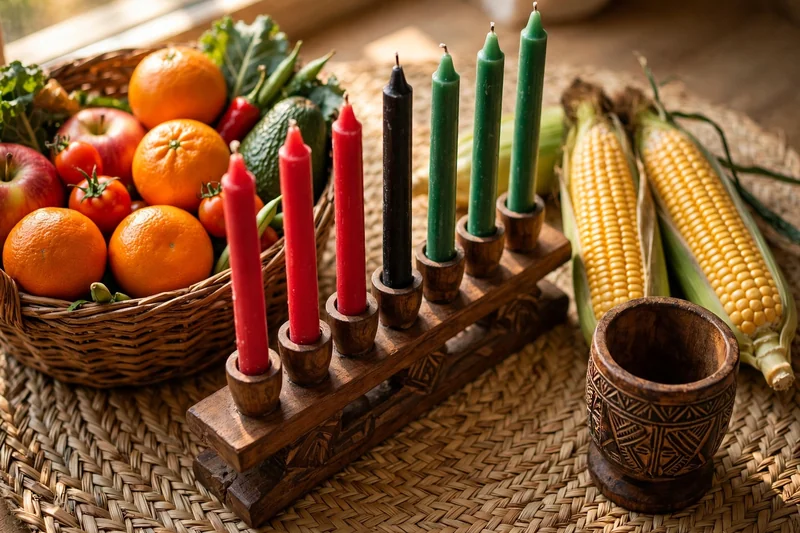
Seven symbols sit at the center of every Kwanzaa table. Each one stands for a part of the holiday, and each one has a Swahili name. Families place them on a woven mat, and they stay there for the whole week.
The seven symbols are:
- Mkeka, the mat. A woven straw mat is laid down first. It stands for tradition, history, and the foundation on which everything else rests.
- Mazao, the crops. Fruits and vegetables are placed in a basket. They stand for the harvest, and for the work of the people who grew the food.
- Muhindi, the corn. One ear of corn is set out for each child in the family. The corn stands for children, and for the future of the community.
- Kinara, the candle holder. The kinara holds the seven candles. It stands for the roots of the people, the ancestors who came before.
- Mishumaa Saba, the seven candles. One black, three red, and three green candles stand for the seven principles. One is lit each night of the week.
- Kikombe cha Umoja, the unity cup. A single cup is passed around and shared. It stands for unity, and it is used in a ceremony to honor the ancestors.
- Zawadi, the gifts. Gifts are set out for the family, often handmade or tied to learning. They stand for the love of parents and the promise made to children.
Two more items often join the table. A book or two may be placed there, to stand for learning, and a piece of African art may be added, to stand for beauty and heritage. The table is not a display for show. It is a place where the family gathers each night, so the symbols are handled, talked about, and passed from hand to hand.
How Is Kwanzaa Celebrated Each Night?
Each night of Kwanzaa follows the same warm pattern. The family gathers around the table, the candles are lit, and the principle of the day is named and talked about. The pattern is simple, and it is the same on all seven nights, so children learn it fast.
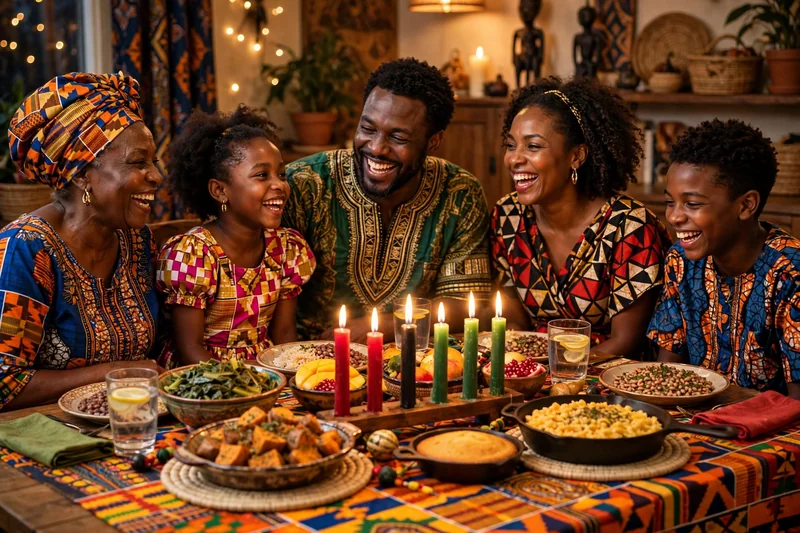
First, the greeting is shared. One person asks Habari Gani, which is Swahili for What is the news. The others answer with the name of that day's principle. On the first night, the answer is Umoja. On the last night, it is Imani. The greeting is the first thing said, and it sets the theme for the evening.
Then the candles are lit. The black candle in the center is lit first, on the night of December 26. After that, one candle is added each night, working outward. Red and green candles take turns, one red, then one green, then red again. By the last night, all seven candles burn together.
Next comes the libation, a short ceremony to honor the ancestors. An adult pours a little water or juice from the unity cup onto the ground, or into a small bowl, while the names of ancestors are spoken. The cup is then passed around, and each person takes a sip. It is a quiet moment, and it ties the living family to those who came before.
After the ceremony, the family talks about the principle of the day. Parents ask children what unity means to them, or what purpose means at school. Stories are told, songs are sung, and elders share memories. The talk is the heart of the night, because the principles are meant to be lived, not just named.
The week builds toward the Karamu, the feast on December 31. Family and friends gather in bright African style clothing for a large shared meal. The table is full of dishes with African roots, such as collard greens, black eyed peas, sweet potatoes, and okra, along with the foods each family loves best. Music, dance, and song fill the evening. The next day, January 1, gifts are often given, and the week closes with the principle of faith.
What Do the Kwanzaa Colors Mean?
Kwanzaa has three colors, and each one has a meaning. Black stands for the people, the African people and their unity. Red stands for the struggle, the blood shed and the hard work of the past. Green stands for the future, and for the hope that comes from the struggle. The three colors appear everywhere in the holiday, in the candles, the cloth, and the decorations.
The candles show the colors in order. The black candle sits in the center of the kinara, and it stands for unity. The three red candles sit to the left, and they stand for self determination, cooperative economics, and creativity. The three green candles sit to the right, and they stand for collective work and responsibility, purpose, and faith.
Many families dress in the three colors during the week, and the table cloth and the gifts often carry them too. The colors are a quick way to spot a Kwanzaa celebration, and they are a reminder of the story the week tells: a people, a struggle, and a hopeful future.
Kwanzaa vs Christmas: What Is the Difference?
Kwanzaa and Christmas share a season, but they are different holidays with different roots. Christmas is a Christian feast that marks the birth of Jesus, and it falls on December 25. Kwanzaa is a cultural celebration of African American heritage, and it runs from December 26 to January 1. One is religious, and the other is cultural, though Kwanzaa has a spiritual quality of its own.
The two holidays also differ in how they are kept. Christmas centers on a single day, with gifts, a feast, and church services. Kwanzaa spreads across seven days, with one principle and one candle each night, and its feast comes on the sixth day. Christmas gifts are often bought in shops. Kwanzaa gifts, called zawadi, are often handmade, or tied to books and learning.
The most common mix up is the idea that Kwanzaa replaces Christmas. It does not. The founder first spoke of it as an alternative, but he later made clear that it was not meant to replace anyone's religion or religious holiday. Many families celebrate both. They keep Christmas on December 25, and then they keep Kwanzaa from December 26 to January 1. The two holidays sit side by side, and neither one takes the place of the other.
There is one more difference worth noting. Christmas is kept all over the world, while Kwanzaa is kept mainly in the United States and in parts of the African diaspora. Both holidays are about family and giving, but they tell different stories, and they belong to different traditions.
Is Kwanzaa a Religious Holiday?
No, Kwanzaa is not a religious holiday. It is a cultural holiday, and the official Kwanzaa website calls it not a religious holiday, but a cultural one with an inherent spiritual quality. People of many faiths keep it, and it sits beside their own religious holidays rather than replacing them.
That is why Christians, Muslims, and people of other faiths can all take part in Kwanzaa. The principles are values, not doctrines, and the ceremonies honor ancestors and community rather than a single faith. A family can go to church on Christmas morning and light the kinara on the night of December 26, with no clash between the two.
The spiritual side of Kwanzaa is real, though. The libation honors the ancestors, the principles ask for faith and purpose, and the week ends with a feast of thanks. It is a holiday with a deep sense of meaning, even though it belongs to no church. That mix of culture and spirit is part of what makes Kwanzaa distinct.
How to Wish Someone a Happy Kwanzaa
The simplest wish is Happy Kwanzaa, and it is always welcome. If you want to greet someone in the spirit of the holiday, ask Habari Gani, which means What is the news. The right answer is the name of the principle for that day, so on December 26 you would answer Umoja, and on January 1 you would answer Imani.
A few points of care will help the greeting land well. First, do not say Merry Christmas to someone who is keeping Kwanzaa, unless you know they also keep Christmas. Happy Kwanzaa is the safer wish in the week after Christmas. Second, do not treat Kwanzaa as a joke or a costume. The candles, the cup, and the mat carry real meaning for the families who use them. Third, if you are invited to a Kwanzaa gathering, go with an open mind. Bring a small gift if you like, take part in the greeting, and listen to the stories. That is the best way to honor the week.
Children often ask the best questions about Kwanzaa, and they are easy to answer. You can tell a child that Kwanzaa is a week when families light one candle each night and talk about seven good ideas, like unity, purpose, and faith. The candles, the corn, and the fruit are all there to help the family remember what matters most.
Frequently Asked Questions About Kwanzaa
What does Kwanzaa mean?
Kwanzaa means first fruits of the harvest. The name comes from the Swahili phrase matunda ya kwanza, and it points to the first fruits festivals of Africa, where the first crops of the harvest are gathered and shared with thanks.
When is Kwanzaa 2026?
Kwanzaa 2026 runs from Saturday, December 26, 2026, to Friday, January 1, 2027. The dates are fixed every year, so Kwanzaa always starts on December 26 and always ends on January 1. The Karamu feast falls on Thursday, December 31, 2026.
What are the seven principles of Kwanzaa?
The seven principles, called the Nguzo Saba, are Umoja (unity), Kujichagulia (self determination), Ujima (collective work and responsibility), Ujamaa (cooperative economics), Nia (purpose), Kuumba (creativity), and Imani (faith). One principle is honored on each day of Kwanzaa, in that order.
What does Habari Gani mean?
Habari Gani is Swahili for What is the news. It is the greeting used during Kwanzaa. One person asks Habari Gani, and the others answer with the name of the principle for that day, such as Umoja on December 26 or Imani on January 1.
Is Kwanzaa a religious holiday?
No, Kwanzaa is not a religious holiday. It is a cultural celebration of African American heritage, with a spiritual quality. People of many faiths keep it beside their own religious holidays, and it does not replace Christmas or any other faith holiday.
How long does Kwanzaa last?
Kwanzaa lasts seven days and seven nights, from December 26 to January 1. One candle is lit each night, and one principle is honored each day. The feast, called the Karamu, is held on the sixth day, December 31.
What is the difference between Kwanzaa and Christmas?
Christmas is a Christian feast on December 25 that marks the birth of Jesus. Kwanzaa is a cultural celebration from December 26 to January 1 that honors African American heritage through seven principles. Kwanzaa does not replace Christmas, and many families celebrate both holidays in the same season.
Do you give gifts during Kwanzaa?
Yes, gifts are part of Kwanzaa, and they are called zawadi. They are often handmade, or tied to books and learning, rather than bought in a shop. Gifts are usually given on January 1, the last day of the week, though some families give them through the week. The point of the gift is love and learning, not cost.
Kwanzaa is a young holiday with deep roots. It was made in 1966, but it reaches back to harvest festivals that are far older. In one week, it holds seven ideas that any family can live by: unity, self determination, shared work, shared wealth, purpose, creativity, and faith. That is what Kwanzaa means, and that is why it is kept each year, from the day after Christmas to the first day of the New Year.
I am Olivia, the passionate writer and creator behind MeaningZime, where I share meaningful insights, inspiring ideas, and engaging content about names, quotes, emotions, and life-related topics. I love exploring the deeper meanings hidden in words and turning them into easy-to-understand articles that inform and inspire readers around the world. Through MeaningZime.com, my goal is to create a place where curiosity meets knowledge and every visitor finds something valuable, relatable, and uplifting.
