
Bhai Dooj meaning: it is the Hindu festival that honours the bond between a brother and a sister. The name comes from two Hindi words, Bhai, which means brother, and Dooj, which means the second day, from the Sanskrit word Dwitiya. On this day, a sister applies a tilak to her brother’s forehead, prays for his long life, and shares a meal with him, while he gives her a gift and promises to protect her. You can read more background on Bhai Dooj on Wikipedia. Bhai Dooj is the last day of the five day Diwali festival, and in 2026 it falls on Tuesday, November 10 in the United States, the United Kingdom, and Canada, and on Wednesday, November 11 in most of India.
In simple words, Bhai Dooj is a family day, not a big public event, with no crowds, no fireworks, and no street fairs. It is a quiet day at home, built around one simple act: a sister blesses her brother, and a brother thanks his sister. That small ritual carries a big idea, that siblings look out for each other for life.
What Does Bhai Dooj Mean?
Bhai Dooj is a name that explains itself, since Bhai means brother in Hindi, and Dooj comes from Dwitiya, the Sanskrit word for the second day of the lunar fortnight. So the name means the second day for brothers.
The festival falls on the second day of the bright fortnight, or Shukla Paksha, in the Hindu month of Kartik, which is the half of the lunar month when the moon grows from new to full. The second day of that half is Dwitiya, and that is when Bhai Dooj is kept.
The timing is no accident, since Bhai Dooj comes two days after Diwali, which falls on the new moon night of Kartik. It closes the five day Diwali festival. After four days of lamps, prayer, and feasts, the last day turns to family, and to the bond between brothers and sisters.
The name also tells you who the day is for, since it is not a day for all family ties, but a day for one tie only, the tie between a brother and a sister. Every ritual on the day points back to that tie.
When Is Bhai Dooj in 2026?
Bhai Dooj follows the Hindu lunar calendar, so its date moves each year. In 2026, the Dwitiya Tithi, the second lunar day, begins on Tuesday, November 10, and ends on Wednesday, November 11, and because the date depends on when the tithi falls in the afternoon, different places keep it on different days.
In the United States, the United Kingdom, and Canada, Bhai Dooj falls on Tuesday, November 10, 2026, while in most of India it falls on Wednesday, November 11, 2026. Australia keeps the same date as India, Wednesday, November 11. If you plan to call a sibling abroad, check which day applies where they live, so your wish lands on the right day.
The best time for the tilak in New Delhi is 1:10 PM to 3:20 PM on Wednesday, November 11, 2026, a window called the Aparahna Muhurat, the afternoon period. In New York, the window falls on Tuesday, November 10, from 12:40 PM to 2:41 PM local time. Times differ by city, so check a local panchang if the exact hour matters to you.
The date shifts each year because the lunar calendar does not match the solar calendar. In 2025, Bhai Dooj fell on Thursday, October 23, and in 2027 it will fall on Sunday, October 31. It always lands in late October or early November, always two days after Diwali.
Why Is Bhai Dooj Celebrated?
Bhai Dooj is celebrated because of a story about Yama, the god of death, and his sister Yamuna, the river goddess, a story that is the heart of the festival and explains both the name Yama Dwitiya and the tilak ritual.
Yamuna had not seen her brother for a long time, and she kept inviting him to her home, but Yama was busy, as the god of death tends to be, and he kept putting off the visit. At last, on the second day of the bright fortnight in Kartik, he came.
Yamuna welcomed him with joy. She washed his feet, applied a tilak to his forehead, circled a lamp before his face in aarti, and served him a feast of his favourite dishes. The two spent a happy day together, talking and eating after their long time apart.
When it was time for Yama to leave, he was moved by his sister’s love and asked her to name a boon, a gift of her choice. Yamuna asked that any brother who visits his sister on this day, and receives her tilak, be blessed with a long life, free from untimely death. Yama agreed.
That promise is why the day is also called Yama Dwitiya, the second day that belongs to Yama, and why sisters pray for their brothers’ long life on this day. The story turns a simple family visit into a blessing that has lasted for ages.
Some tellings add that Yama also said siblings who bathe in the Yamuna river on this day would not meet misfortune, and the river itself is part of the tale, since Yamuna the goddess and Yamuna the river are one and the same.
The Krishna and Subhadra Story
There is a second story behind Bhai Dooj, told in many homes in North India, which features Lord Krishna and his sister Subhadra, and links the festival to the days just before Diwali.
After Krishna defeated the demon Narakasura, he visited his sister Subhadra, who welcomed him home with sweets and flowers, performed aarti, and applied a tilak to his forehead. Her welcome marked his safe return, and the act became a model for sisters ever since.
Some families tell the Yama story, and some tell the Krishna story, while many tell both. The two tales agree on the same point: a sister’s welcome, marked by a tilak, brings safety and long life to her brother. The festival holds both stories side by side, and neither cancels the other.
How Bhai Dooj Is Celebrated
The ritual of Bhai Dooj is simple, and that is part of its strength. It needs no priest, no temple visit, and no grand setup. A home, a lamp, a small plate, and two siblings are enough.
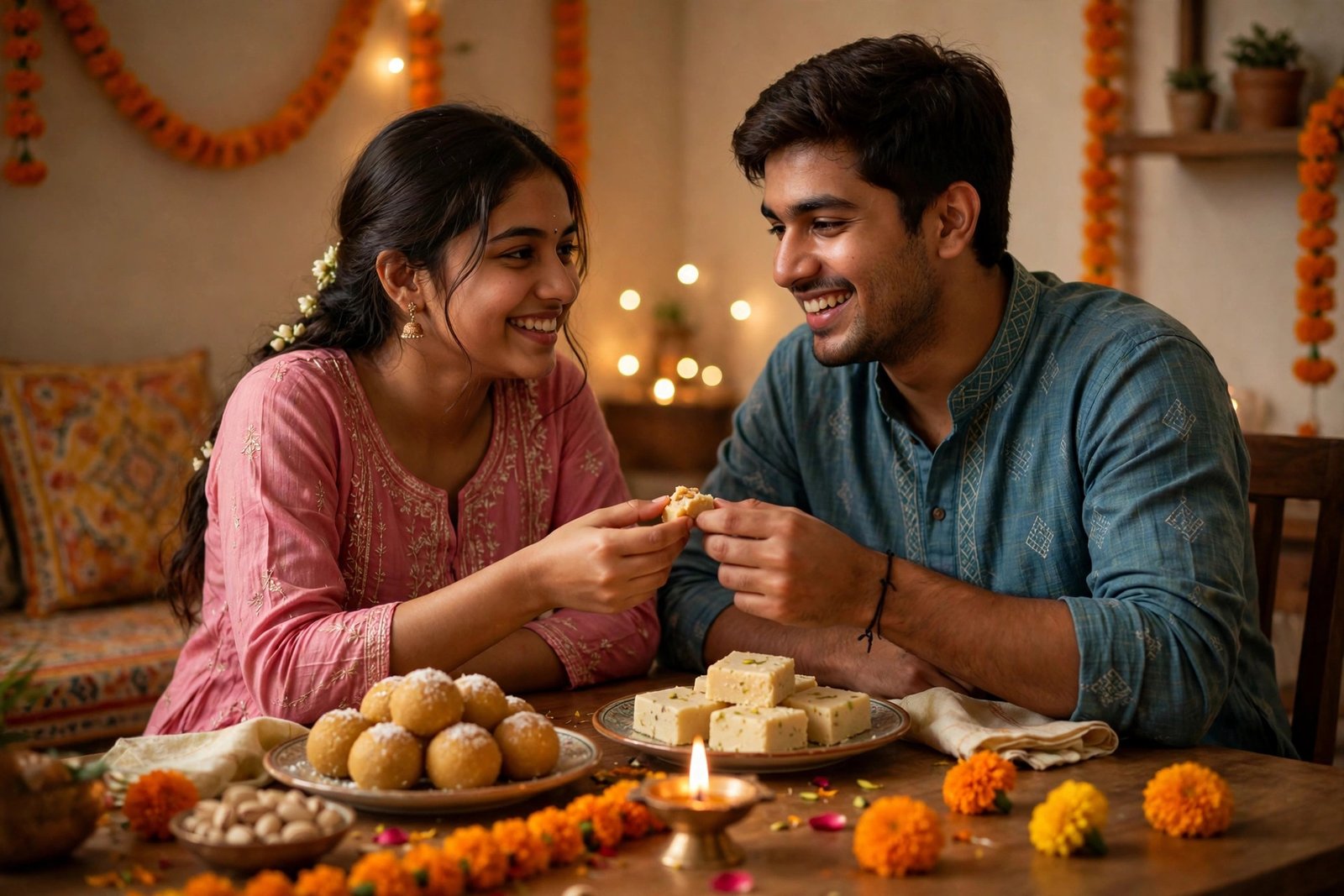
First, the sister invites her brother to her home, or visits him at his, then prepares his favourite dishes and sweets, and sets out a plate with a lamp, kumkum, rice, and flowers. The brother sits facing her, often with his hands folded.
Next comes the tilak, when the sister applies a mark to her brother’s forehead, made from kumkum, sandalwood paste, or turmeric mixed with rice. The tilak is a sign of blessing and protection. In some homes, she also ties a thread on his wrist, much like a rakhi.
Then she performs aarti, circling a lit lamp before his face, praying aloud for his long life and health, and offering him sweets. The brother touches her feet in some families, or simply thanks her, and gives her a gift in return. The gift may be money, clothes, jewellery, or anything thoughtful.
Finally, they eat together, and the shared meal is the heart of the day. It is the part the old stories stress most: Yamuna fed Yama, and Subhadra fed Krishna. Food shared between siblings is the festival in its simplest form.
When siblings live far apart, the day still works, since many families now mark Bhai Dooj over a video call. The sister applies a tilak to a photo, or simply says the prayer aloud, and the brother sends a gift online. The distance changes the form, but the meaning stays the same.
What Bhai Dooj Is Called in Different Regions
Bhai Dooj has many names, and each one shows how the festival travels across India and beyond, while the ritual stays close to the same, though the name changes with the map.
- Bhai Dooj or Bhaiya Dooj: the common name in North India, where Bhaiya is a fond word for an elder brother.
- Bhau Beej: the name in Maharashtra and Goa, where Beej means the second day, just as Dooj does.
- Bhai Tika: the name in Nepal, where it is also called Bhai Tihar, the festival of brothers. Sisters there apply a seven colour tilak, known as the Saptarangi Tika.
- Bhai Phonta: the name in West Bengal, where the sister’s prayer asks that thorns be placed at Yama’s door, so he cannot enter and take her brother.
- Yama Dwitiya: the name in South India, which points straight to the Yama and Yamuna story.
- Bhratri Dwitiya: the formal Sanskrit name, used in older texts. Bhratri means brother.
A second Bhai Dooj also falls in spring, after Holi, in the month of Chaitra, and it is kept by some communities, such as the Kayasthas, who mark two Bhai Doojs each year, though the autumn one, after Diwali, is the one most people know.
Bhai Dooj vs Raksha Bandhan: What Is the Difference?
People often mix up Bhai Dooj and Raksha Bandhan, since both honour the bond between brothers and sisters. They are kin, but they are not the same festival.
Raksha Bandhan falls in August, on the full moon of Shravan, and its central act is the rakhi, a thread the sister ties on her brother’s wrist. Bhai Dooj falls in late October or early November, two days after Diwali. Its central act is the tilak, a mark on the brother’s forehead.
On Raksha Bandhan, the thread is the promise, since the brother vows to protect his sister, and the thread is the sign of that vow. On Bhai Dooj, the prayer is the promise. The sister prays for her brother’s long life, and the tilak is the sign of that prayer.
Both days end the same way: a gift, a meal, and time together. If Raksha Bandhan is the festival of protection, Bhai Dooj is the festival of long life. Many families keep both, one in summer and one in autumn, as two halves of the same bond.
How to Wish Someone a Happy Bhai Dooj
A Bhai Dooj wish is short and warm. It names the bond, and it asks for a long and happy life. Here are a few plain examples you can use in a text or a card:
- Happy Bhai Dooj! May your life be long, bright, and full of sweet moments.
- Happy Bhai Dooj to the best brother. Thank you for always standing by me.
- On Bhai Dooj, I pray for your health, your happiness, and a long life. Love you, bhai.
- Happy Bhai Dooj! Distance cannot dim our bond. You are always in my prayers.
- Happy Bhai Dooj, sister. Your blessings mean the world to me, today and always.
Keep the wish personal if you can, and add a shared memory, a joke only the two of you know, or a line about the year gone by, since a wish that sounds like you will mean more than a polished line copied from a list.
Frequently Asked Questions
What does Bhai Dooj mean?
Bhai Dooj means the second day for brothers, since Bhai means brother, and Dooj comes from Dwitiya, the second day of the bright fortnight in the Hindu month of Kartik. It is the festival where a sister applies a tilak to her brother’s forehead and prays for his long life.
When is Bhai Dooj in 2026?
In 2026, Bhai Dooj falls on Tuesday, November 10 in the United States, the United Kingdom, and Canada, and on Wednesday, November 11 in most of India. The Dwitiya Tithi runs from Tuesday, November 10 to Wednesday, November 11, so the day shifts by place.
Why is Bhai Dooj celebrated?
Bhai Dooj is celebrated for the story of Yama and Yamuna, since when Yama visited his sister Yamuna, she welcomed him with a tilak, aarti, and a feast, and he blessed her wish that any brother who receives his sister’s tilak on this day would live a long life. A second story tells of Krishna visiting his sister Subhadra after defeating Narakasura.
What is Bhai Dooj called in Maharashtra?
In Maharashtra and Goa, Bhai Dooj is called Bhau Beej. Bhau means brother in Marathi, and Beej means the second day. The ritual is the same: a sister applies a tilak, performs aarti, and shares a meal with her brother.
Is Bhai Dooj the same as Raksha Bandhan?
No. Raksha Bandhan falls in August and centres on the rakhi thread, while Bhai Dooj falls two days after Diwali and centres on the tilak. Both honour the brother and sister bond, but they are separate festivals with separate rituals.
What do sisters do on Bhai Dooj?
On Bhai Dooj, a sister invites her brother home, applies a tilak of kumkum and rice to his forehead, performs aarti with a lit lamp, prays for his long life and health, and serves him a meal of his favourite dishes. The brother gives her a gift and promises to protect her.
Bhai Dooj meaning is easy to hold onto once you know the story. It is the second day of the bright half of Kartik, the last day of Diwali, and a day when a sister’s prayer asks for one thing above all: a long life for her brother. In 2026, that day falls on Tuesday, November 10 in the United States, the United Kingdom, and Canada, and on Wednesday, November 11 in most of India. Mark the date, call your sibling, and keep the bond bright.

I am Olivia, the passionate writer and creator behind MeaningZime, where I share meaningful insights, inspiring ideas, and engaging content about names, quotes, emotions, and life-related topics. I love exploring the deeper meanings hidden in words and turning them into easy-to-understand articles that inform and inspire readers around the world. Through MeaningZime.com, my goal is to create a place where curiosity meets knowledge and every visitor finds something valuable, relatable, and uplifting.
