

The winter solstice meaning is simple at its core, because it is the moment in the year when one half of the Earth tilts farthest away from the Sun. In the Northern Hemisphere, that moment brings the shortest day and the longest night of the year. After it passes, the days start to grow longer again, one minute at a time.
The winter solstice falls on Monday, December 21, 2026, at 3:50 p.m. EST, which is the exact moment of the solstice in the United States and also the first day of astronomical winter. People have marked this turning point for thousands of years, with fires, feasts, and quiet time with family. This guide explains what the winter solstice is, why it happens, when it falls in 2026, and how people around the world still mark it today. If you want the wider picture of the season, read our guide to winter meaning. If you want the holiday that follows four days later, read our guide to Christmas meaning.
Winter Solstice Meaning in Simple Words
The winter solstice is the day with the least daylight in the Northern Hemisphere, because the Sun rises late, stays low in the sky, and sets early. In New York, for example, the Sun rises near 7:16 a.m. and sets near 4:31 p.m. on December 21, 2026, which gives the city only about 9 hours and 15 minutes of daylight. The night that follows is the longest night of the year.
The word solstice comes from Latin, where sol means sun and sistere means to stand still. To people watching the sky long ago, the Sun seemed to stop in place, because each day it rose a little lower and set a little earlier. Then, at the solstice, it stopped its slide and turned back, and the days began to grow longer again.
The winter solstice is also called midwinter, the shortest day, and the longest night. It is both an event in the sky and a day on the calendar, since the exact solstice lasts only a moment, but we use the term for the whole day as well. That is why you will see both uses, and both are correct.
The solstice matters because it is a turning point, although it does not mark the coldest day of the year. The coldest days often come in January or February, after the land and sea have had time to cool. But the solstice marks the point when light starts to return. For people in cold, dark places, that return of light has always been a reason to hope.
When Is the Winter Solstice in 2026?
The winter solstice in 2026 falls on Monday, December 21, 2026, at 3:50 p.m. EST. In Pacific Time, that is 12:50 p.m. PST, while in London it is 8:50 p.m. GMT, and in Coordinated Universal Time it is 20:50 UTC. The moment is the same all over the world, and only the clock time changes with your time zone.
The date shifts a little from year to year, and in the Northern Hemisphere, the winter solstice usually falls on December 21 or 22. The shift happens because the calendar year is not exactly the same length as the time Earth takes to orbit the Sun, so leap years and the slow drift of the calendar move the date by a day now and then. In 2026, it is December 21.
Here is what to keep in mind about the 2026 date. The solstice is a single moment, not a full day of stillness, and it happens at 3:50 p.m. EST on December 21. So the shortest day is December 21 in most of the United States. In places far to the east, such as Sydney, Australia, the same moment falls on December 22 by the local clock. That is why some sources list December 22 for the solstice in those places, although the event is the same and only the local date differs.
If you want to watch it, the best time is sunset on December 21, when the Sun sets at its most southerly point on the horizon. From then on, each sunset moves a little farther north, and each day gains a little more light. By the end of December, the change is small, only a few minutes, but by late January, the extra light is easy to feel.
Why Is the Winter Solstice the Shortest Day of the Year?
The short answer is tilt, because Earth spins on an axis that is tilted about 23.5 degrees. As Earth moves around the Sun, that tilt points one pole toward the Sun and the other pole away from it. In December, the North Pole points away from the Sun. The Northern Hemisphere gets less direct sunlight, and the days grow short.
Think of it like a torch held at an angle. When the light hits straight on, it is bright and strong, but when it hits at a low angle, it spreads thin and weak. In December, sunlight hits the Northern Hemisphere at a low angle, so the Sun stays low in the sky, even at noon. Your shadow at midday is the longest it will be all year, less light reaches the ground, and the air stays cold.
The Sun also takes a short path across the sky in December, because it rises in the southeast, arcs low, and sets in the southwest. It spends fewer hours above the horizon, and that is why the day is short. The night fills the rest of the 24 hours, which is why the winter solstice brings the longest night.
The far north sees this effect most of all. In parts of Alaska, the Sun barely rises at all near the solstice, and in the Arctic, it does not rise for weeks. Closer to the equator, the change is small, because in Miami, the shortest day still has more than 10 hours of daylight. The farther you live from the equator, the more the solstice changes your day.
After the solstice, the tilt starts to work in the other direction, and the North Pole slowly turns back toward the Sun. Each day gains a minute or two of light, and the change is slow at first. But it never stops until the summer solstice in June, when the Northern Hemisphere has its longest day.
What Does the Word Solstice Mean?
Solstice comes from the Latin word solstitium, which joins two parts: sol, which means sun, and sistere, which means to stand still. Put together, the word means the sun stands still, and ancient sky watchers gave it this name because the Sun seemed to pause.
Through the autumn, the Sun rises farther south each morning and sets farther south each evening. The arc it makes across the sky gets lower and shorter. Then, around the solstice, the change slows to a stop, and for a few days, the sunrise and sunset points barely move. To the eye, the Sun stands still, and then it turns, and the arc starts to grow again.
There are two solstices each year. The winter solstice is the one with the least daylight in your half of the world. The summer solstice is the one with the most daylight. They are opposites, because when the Northern Hemisphere has its winter solstice in December, the Southern Hemisphere has its summer solstice at the same moment.
The word equinox is different, because it comes from Latin words that mean equal night. On an equinox, day and night are nearly equal in length, and the equinoxes fall in March and September. The solstices are the extremes, while the equinoxes are the middle points.
Winter Solstice vs Summer Solstice
The winter solstice and the summer solstice are mirror images, because both come from the same tilt of the Earth, but they bring opposite results.
The winter solstice brings the shortest day and the longest night, with the Sun at its lowest point in the sky. It rises late and sets early, and in the Northern Hemisphere, it falls in December. It marks the start of astronomical winter.
The summer solstice brings the longest day and the shortest night, with the Sun at its highest point in the sky. It rises early and sets late, and in the Northern Hemisphere, it falls in June. It marks the start of astronomical summer.
Here is a simple way to keep them straight. Winter solstice means least light, while summer solstice means most light. The winter solstice is the darkest day, and the summer solstice is the brightest day.
Both solstices happen at the same moment in both hemispheres, but their names flip. When it is the winter solstice in New York, it is the summer solstice in Sydney. When it is the summer solstice in New York, it is the winter solstice in Sydney. The seasons are reversed below the equator.
Is the Winter Solstice the First Day of Winter?
Yes, by the astronomical calendar, the winter solstice is the first day of winter. Astronomers define the seasons by the solstices and the equinoxes, so winter starts at the December solstice and ends at the March equinox. In 2026, astronomical winter runs from December 21 to March 20, 2027.
But there is another way to count the seasons. Weather watchers use the meteorological calendar, which splits the year into neat three month blocks. By that count, winter starts on December 1 and ends on February 28. This system is simpler for keeping weather records, because it groups the coldest months together.
So both answers are right, and they serve different needs. If you follow the sky, winter starts on December 21, 2026, while if you follow the weather calendar, winter started on December 1. Most people use the two counts without thinking about it. The solstice date is the one that marks the return of light, which is why it has always drawn more attention.
One more detail surprises many people. The earliest sunset of the year does not fall on the solstice, because in the northern United States, the earliest sunset comes in early December, about two weeks before the solstice. The latest sunrise comes in early January, after the solstice, and this happens because clock time and sun time drift apart through the year. The solstice is still the shortest day in total, even though the sunset stopped getting earlier before it arrived.
Winter Solstice Traditions Around the World
People have marked the winter solstice since long before written history, because the return of light after the darkest day gave hope in a hard season. Food stores were low, the nights were long, and the cold was deep, so a feast at the solstice was both a comfort and a promise that spring would come. Many of the customs from those old feasts still live on in the holidays we keep today.
Yule is one of the oldest solstice traditions, and it comes from the Germanic peoples of northern Europe. Families brought evergreen branches into the home to stand for life through the dark. They burned a Yule log, a large log chosen to burn through the longest night. The fire and the light stood for warmth and hope. Many Yule customs, such as evergreen wreaths and the Yule log cake, still appear at Christmas today.
The Dongzhi Festival is the Chinese winter solstice festival, where Dongzhi means the arrival of winter. Families gather for a meal and eat tangyuan, small balls of glutinous rice in sweet soup. The round shape stands for family unity and the return of light. In northern China, people eat dumplings instead, and Dongzhi is a time to be with family, much like Thanksgiving or Christmas in the United States. The festival falls on the solstice itself, so in 2026 it falls on December 21.
Saturnalia was the Roman festival held near the solstice, and it honored Saturn, the god of farming. The festival ran from December 17 to December 23, with feasting, gift giving, and candles, and roles were turned upside down for a few days. Slaves dined with masters, and people wore loose, bright clothes, while many Saturnalia customs, such as candles, wreaths, and small gifts, were later folded into Christmas.
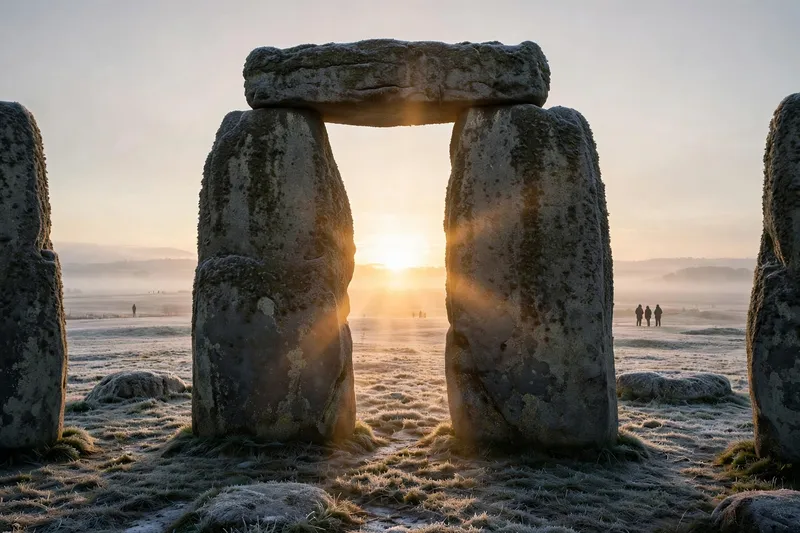
Stonehenge in England is one of the most famous solstice sites, because the stones were set so the Sun sets through them on the winter solstice. Thousands of people still gather there each year to watch the sunset on the shortest day, and Newgrange in Ireland is older still. It is a passage tomb built more than 5,000 years ago, and at sunrise on the winter solstice, a shaft of light enters the tomb and lights the inner chamber. The builders planned it with care, and it still works today.
Shab-e Yalda is the Persian festival of the longest night, and it is marked in Iran and parts of Central Asia. Families stay up late, eat pomegranates and watermelon, and read poetry, while the red fruit stands for the dawn and the warmth of the coming sun. The night is a time for stories, and the morning brings the first lengthening of the day.
The Hopi people of the American Southwest mark Soyal, a winter solstice ceremony, which is a time of prayer for the return of the Sun and for the health of the community. The ceremony looks ahead to the new year and the planting season to come. It is a quiet, sacred event, much of which is private to the community.
These traditions differ in detail, but they share one idea. The darkest day is not the end, because it is the turn, and light comes back, and life goes on. That is why the solstice has always been a time for hope.
The Spiritual Meaning of the Winter Solstice
Beyond the science, the winter solstice carries a deep spiritual meaning for many people, because it is seen as a time of rest, reflection, and renewal. The long night invites stillness, while the return of light invites hope.
In many modern spiritual practices, the solstice is a time to let go of the old year and set aims for the new one. People write down what they want to leave behind and what they want to carry forward. Some light a candle at sunset and let it burn as a sign of the returning Sun. Others spend the evening in silence, or in prayer, or in quiet talk with family.
The solstice is not a religious holiday in itself, because it is an event in the sky, but many faiths and cultures mark it. Some see it as a symbol of rebirth, and some see it as a reminder that dark times pass. The Romans called the solstice season the birthday of the unconquered Sun, and that phrase, Dies Natalis Invicti Solis, still fits the feeling of the day. The Sun may sink low, but it is not beaten, because it comes back.
For people who follow the seasons closely, the solstice is also a time to rest. The land rests in winter, animals slow down, and old farming life followed the same rhythm, with hard work in summer and quiet repair in winter. The solstice gives us a reason to slow down too, and to gather strength for the year ahead.
How to Celebrate the Winter Solstice
You do not need a big event to mark the solstice, because a few simple acts can make the day feel special. Here are seven easy ways to mark the winter solstice in 2026.

- Watch the sunset on December 21, and step outside near sunset to watch the Sun sink at its most southerly point. It is the lowest sunset of the year, and it marks the turn toward longer days.
- Light a candle at dusk, because a single candle in a dark room is a small echo of the returning light. Some families light one candle for each person at the table.
- Take a walk in nature, because a short walk in the cold air, even in a park, can clear your mind. Look at the long shadows, because they are at their longest on this day.
- Share a warm meal with family or friends, and cook something slow and warm, such as soup or stew. The old solstice feasts were about food and company, not fancy plans.
- Bring evergreen branches inside, because a few pine or fir branches in a vase stand for life that keeps going through the dark. It is a simple, old custom that still works.
- Write down one thing to leave behind and one thing to welcome, because the solstice is a natural point to close the old year. A short note to yourself is enough.
- Look at the stars after dark, because the longest night gives the longest view of the sky. On a clear night, the stars are bright, and the winter constellations are easy to find.
Any one of these is enough, because the point is not to do them all. It is to pause for a moment on the darkest day and note that the light is on its way back.
Winter Solstice in the Southern Hemisphere
The winter solstice is not the same day everywhere, because in the Southern Hemisphere, the seasons run in reverse. When the North has its winter solstice in December, the South has its summer solstice. The December solstice is the longest day of the year in Australia, New Zealand, South Africa, and South America.
The Southern Hemisphere has its own winter solstice in June, and in 2026, it falls on June 21. That is the shortest day of the year below the equator. People in Sydney mark it with cold nights and short days, just as people in New York mark the December solstice.
This flip is easy to forget, but it is a good check on what the solstice really is. It is not about cold or snow, because it is about tilt and light. The same tilt that gives the North its darkest day gives the South its brightest day, at the same moment.
If you have friends in the Southern Hemisphere, the December solstice means something different to them, because they are at the start of summer. Their days are long, and their nights are short, while the solstice links the two halves of the world in one shared moment.
Frequently Asked Questions About the Winter Solstice
What does winter solstice mean?
The winter solstice means the moment when one half of the Earth tilts farthest away from the Sun. It brings the shortest day and the longest night of the year in that half of the world. In the Northern Hemisphere, it falls in December, and after it passes, the days start to grow longer.
When is the winter solstice in 2026?
The winter solstice in 2026 falls on Monday, December 21, 2026, at 3:50 p.m. EST, which is 12:50 p.m. PST and 20:50 UTC. The moment is the same worldwide, but the clock time shifts with your time zone.
Why is the winter solstice the shortest day of the year?
The winter solstice is the shortest day because the North Pole tilts farthest away from the Sun, so sunlight hits the Northern Hemisphere at a low angle. The Sun takes a short, low path across the sky. It rises late and sets early, so daylight lasts only a few hours in far northern places.
What happens on the winter solstice?
On the winter solstice, the Sun reaches its lowest point in the sky and its most southerly point on the horizon. The day has the least daylight of the year. From the next day on, the days grow longer, and many people mark the day with candles, feasts, and quiet time with family.
Is the winter solstice the first day of winter?
Yes, by the astronomical calendar, the winter solstice is the first day of winter, and astronomical winter in 2026 runs from December 21 to March 20, 2027. By the weather calendar, winter starts on December 1, and both counts are used, and both are correct for their own purpose.
What is the difference between the winter solstice and the summer solstice?
The winter solstice is the shortest day of the year, and the summer solstice is the longest day. The winter solstice falls in December in the Northern Hemisphere, and the summer solstice falls in June. When one half of the world has its winter solstice, the other half has its summer solstice.
How long is the winter solstice night?
The night of the winter solstice is the longest night of the year. In New York, the night lasts about 14 hours and 45 minutes, while in far northern places, it lasts much longer. In the Arctic, the Sun does not rise at all for weeks around the solstice.
Is the winter solstice the same as Christmas?
No, the winter solstice and Christmas are not the same. The solstice is an event in the sky that falls on December 21 in 2026, while Christmas is a Christian holiday that falls on December 25. But some Christmas customs, such as evergreen branches, candles, and the Yule log, come from older solstice traditions.
The winter solstice is the darkest day, and it is also the day the light turns back. That is why people have marked it for thousands of years, from Stonehenge to the Dongzhi table. It is a small event in the sky with a large meaning. The days will grow longer from here, while spring, though far off, is on its way. If you want to keep exploring the season, read our guide to December meaning, our guide to Christmas Eve meaning, and our guide to New Year meaning, and mark December 21, 2026, on your calendar.

I am Olivia, the passionate writer and creator behind MeaningZime, where I share meaningful insights, inspiring ideas, and engaging content about names, quotes, emotions, and life-related topics. I love exploring the deeper meanings hidden in words and turning them into easy-to-understand articles that inform and inspire readers around the world. Through MeaningZime.com, my goal is to create a place where curiosity meets knowledge and every visitor finds something valuable, relatable, and uplifting.
