

New Year’s Eve meaning is simple. It is the last day of the year, December 31, the evening and the night before New Year’s Day. People use the phrase for the whole day, but the word Eve points to the evening, when the real celebration starts. On this night, people look back at the year that is ending and look ahead to the year that is about to begin. In 2026, New Year’s Eve falls on Thursday, December 31, and the new year starts at midnight, when the calendar turns to Friday, January 1, 2027.
Like Christmas Eve, the name comes from the evening before the big day. The night is a doorway between the old year and the new one. Some people spend it at a loud party with fireworks, while others stay at home with family, a quiet dinner, and a countdown on TV. Both ways fit the meaning of the night: close the old year with thanks, and open the new year with hope.
New Year’s Eve Meaning in Simple Words
New Year’s Eve meaning is the last day of the year, December 31, in the Gregorian calendar, the calendar most of the world uses. It is the evening and the night before New Year’s Day, January 1, and it marks the end of one year and the start of the next.
The phrase has two other names you may see. In many countries it is called Old Year’s Day, because it is the last day of the old year, and it is also called Saint Sylvester’s Day, after Pope Sylvester I, whose feast day falls on December 31. In much of Europe, people still call the night Silvester.
In short, when someone says New Year’s Eve, they mean December 31, the night we say goodbye to the old year and hello to the new one.
Why Is It Called New Year’s Eve?
The word Eve comes from the Old English word aefen, which means evening. In old use, an eve was the evening or the night before an important day, so New Year’s Eve is the evening before New Year’s Day.
There is a good reason for this: long ago, many people counted a new day as starting at sunset, not at midnight, so the evening before a feast was already part of the feast. That is why the night before Christmas is Christmas Eve, and the night before the New Year is New Year’s Eve. The old rule still shows in the way we celebrate: the party starts in the evening, and the new year arrives at midnight.
The name is not about the year being over at sunset. It is about the evening that leads into the new day, and at midnight, the old year ends and the new year begins.
When Is New Year’s Eve in 2026?
New Year’s Eve 2026 is Thursday, December 31, 2026. The date never changes, because New Year’s Eve is always December 31, the last day of the year. In 2026, which is not a leap year, December 31 is the 365th day of the year.
At midnight, the calendar turns to Friday, January 1, 2027, which is New Year’s Day. Because New Year’s Day is a Friday in 2027, many people get a long weekend, with the holiday on Friday and the weekend right after it.
The new year does not arrive everywhere at the same time. It follows the local time zone. The first places to welcome the new year are the Line Islands of Kiribati, Samoa, and Tonga, in the Pacific Ocean. The last places are American Samoa, Baker Island, and Howland Island. So when it is already 2027 in Tonga, it is still the morning of December 31 in parts of the United States.
Where Did New Year’s Eve Come From?
People have marked the turn of the year for thousands of years. The date has changed over time, but the wish behind it has stayed the same: to close the old year well and to start the new one with hope.
The oldest known new year festival is Akitu, from Babylon, about 4,000 years ago. It was a spring festival that lasted many days and marked renewal and the start of a new cycle. For the Babylonians, the new year came with the spring, not in the middle of winter.
The Romans later tied the new year to Janus, the god of beginnings and endings. Janus had two faces, one that looked back at the past and one that looked ahead to the future. That is a good image for New Year’s Eve itself: one face on the year gone by, and one face on the year to come. The month of January takes its name from Janus.
In 46 BCE, Julius Caesar reformed the Roman calendar. His Julian calendar fixed January 1 as New Year’s Day, which put the last day of the year on December 31 for the first time. Later, in 1582, Pope Gregory XIII introduced the Gregorian calendar, which fixed the small errors in the Julian calendar. The Gregorian calendar is the one most of the world uses today, and it kept January 1 as New Year’s Day and December 31 as New Year’s Eve.
The name Silvester comes from the same period. Pope Sylvester I died on December 31, in the year 335. The church marks his feast day on December 31, so in many European countries, including Germany, Austria, Poland, France, and Italy, the night is called Silvester, after the saint.
How Is New Year’s Eve Celebrated Around the World?
New Year’s Eve is celebrated in many ways, but most of them share the same parts: a countdown, a cheer at midnight, fireworks, and time with the people you love.
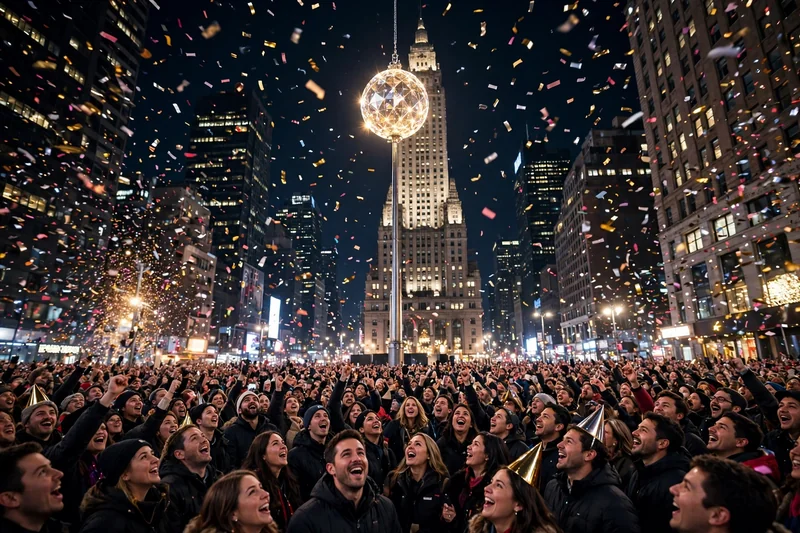
In the United States, the best known celebration is the ball drop in Times Square, New York City. At 11:59 p.m. Eastern Time, a large glowing ball is lowered down a pole on the roof of One Times Square. It reaches the bottom at midnight, and the crowd cheers as the new year begins. The first ball drop was in 1907, when the first ball was made of iron and wood and weighed 700 pounds. Today’s ball weighs 11,875 pounds, is 12 feet wide, and is covered in 2,688 Waterford Crystal triangles. The ball has dropped almost every year since 1907, with the only breaks in 1942 and 1943, when wartime rules kept Times Square dark. About one million people gather in Times Square each year to watch it in person.
In Scotland, the night is called Hogmanay. People go first footing, which means being the first person to step into a friend’s home after midnight. The first footer brings a small gift, such as coal, bread, or whisky, to wish the home luck for the new year.
In Spain and many Spanish speaking countries, people eat twelve grapes at midnight, one grape for each stroke of the clock, and each grape is meant to bring luck for one month of the new year. The custom is called las doce uvas de la suerte, the twelve grapes of luck.
In Japan, the night is called Omisoka. Families clean their homes to welcome the new year, and Buddhist temples ring their bells 108 times at midnight. The ringing is called Joya no Kane, and each ring stands for one of the 108 worldly desires that people hope to leave behind.
In the United States, many Black churches hold Watch Night services on December 31. The tradition began on December 31, 1862, when people gathered in churches to wait for the Emancipation Proclamation, which took effect on January 1, 1863, and the service is a time of prayer, thanks, and hope.
In Boston, a family friendly tradition called First Night began in 1976. It offers parades, ice sculptures, music, and art, with no alcohol, and December 31, 2026 marks its 51st edition.
Many people also sing Auld Lang Syne at midnight. The song comes from a poem by the Scottish poet Robert Burns, written in 1788, and it asks whether old friends should be forgotten, and answers no. The bandleader Guy Lombardo made it the midnight song in the United States from 1929, and it has stayed that way ever since.
How People Celebrate New Year’s Eve at Home
Not every New Year’s Eve needs a big party. Many people stay home, and a quiet night can be just as good.

A home celebration often starts with a special dinner, then games, music, or a film while the family waits for midnight. At ten seconds to midnight, someone starts the countdown: ten, nine, eight, all the way to one, and then everyone cheers, hugs, and wishes each other a happy new year.
Some families write down their hopes for the new year on small pieces of paper. Others make a list of three good things from the old year and three hopes for the new one. Children often get sparklers, party hats, and noise makers, and they love the moment the clock strikes twelve.
If you stay home, you can still watch the Times Square ball drop on TV. Many channels show the countdown live, so you can cheer along with the crowd from your own living room.
New Year’s Eve vs New Year’s Day: What Is the Difference?
People mix up New Year’s Eve and New Year’s Day, but they are two different days.
New Year’s Eve is December 31, the last day of the old year. It is a night for looking back, for parties, fireworks, and countdowns. The mood is farewell: goodbye to the year that is ending.
New Year’s Day is January 1, the first day of the new year. It is a day for looking ahead, for rest, for parades, and for the first steps of new resolutions. The mood is welcome: hello to the year that is starting.
In simple terms, the Eve is the goodbye party, and the Day is the fresh start. The two belong together, and you cannot have one without the other, because the midnight between them is the line where the old year ends and the new year begins.
Is New Year’s Eve a Holiday?
New Year’s Eve is not a federal holiday in the United States. Federal offices, banks, and post offices follow a normal weekday schedule on December 31, though many close early, while New Year’s Day, January 1, is the federal holiday.
In some other countries, December 31 is a public holiday. Thailand, for example, lists both December 31 and January 1 as official holidays, and the rule changes from country to country, so it is worth checking the local calendar where you live.
Even where it is not a holiday, New Year’s Eve is treated as a special night. Shops may close early, restaurants book up fast, and public transport often runs late to carry party goers home after midnight.
What Does NYE Mean in Text?
NYE is short for New Year’s Eve. It is the first letters of New, Year, and Eve, put together, and people use it in texts, chats, captions, and social media posts because it is quick to type.
You will see it in plans and greetings. People write “What are you doing for NYE?” or “Happy NYE!” It means the same as New Year’s Eve, and it is fine to use in casual messages, but in formal writing, it is better to write the full phrase, New Year’s Eve.
The short form became popular in the 20th century, as the night grew into a big public event with parties, TV specials, and countdowns. Today, NYE is one of the most common short forms you will see in December.
How to Use New Year’s Eve in a Sentence
Here are five simple examples that show how people use the phrase in real life:
- We are spending New Year’s Eve at home with family this year.
- The fireworks on New Year’s Eve were the best part of the night.
- She made a resolution on New Year’s Eve to read one book each month.
- They met on New Year’s Eve, just as the clock struck midnight.
- What are your plans for New Year’s Eve 2026?
New Year’s Eve Meaning: Frequently Asked Questions
What does New Year’s Eve mean?
New Year’s Eve means December 31, the last day of the year and the evening before New Year’s Day. It is the night when people say goodbye to the old year and welcome the new one.
Why is it called New Year’s Eve?
It is called New Year’s Eve because Eve means evening, from the Old English word aefen. It is the evening before New Year’s Day, and long ago, days were counted as starting at sunset, so the evening before a feast was part of the feast.
When is New Year’s Eve 2026?
New Year’s Eve 2026 is Thursday, December 31, 2026. At midnight, the year turns to Friday, January 1, 2027, which is New Year’s Day.
Is New Year’s Eve a holiday?
New Year’s Eve is not a federal holiday in the United States, though many businesses close early. New Year’s Day, January 1, is a federal holiday, while in some countries, such as Thailand, December 31 is a public holiday.
What is the difference between New Year’s Eve and New Year’s Day?
New Year’s Eve is December 31, the last day of the old year, a night for parties and countdowns. New Year’s Day is January 1, the first day of the new year, a day for rest and fresh starts.
What does NYE stand for?
NYE stands for New Year’s Eve. It is a short form used in texts, chats, and social media.
What is Saint Sylvester’s Day?
Saint Sylvester’s Day is another name for December 31. It marks the feast day of Pope Sylvester I, who died on December 31, in the year 335, and in many European countries, New Year’s Eve is still called Silvester.
New Year’s Eve is more than a date on the calendar. It is the one night of the year when the whole world stops at the same line, the line between what was and what will be. Whether you spend it under fireworks in a city square or at home with the people you love, the meaning is the same: thank the old year for what it gave, and step into the new year with hope.
I am Olivia, the passionate writer and creator behind MeaningZime, where I share meaningful insights, inspiring ideas, and engaging content about names, quotes, emotions, and life-related topics. I love exploring the deeper meanings hidden in words and turning them into easy-to-understand articles that inform and inspire readers around the world. Through MeaningZime.com, my goal is to create a place where curiosity meets knowledge and every visitor finds something valuable, relatable, and uplifting.

2 thoughts on “New Year’s Eve Meaning: What It Means, Why It Is Called Eve, and the 2026 Date”