
Every June, cities around the world are painted in rainbow colors. Flags fly, crowds march, music fills the streets, and millions of people gather to celebrate who they are — openly, joyfully, and without apology. But Pride Month is far more than a festival. It is a living monument to decades of struggle, sacrifice, and hard-won progress. Understanding where Pride began, and why it continues to matter, is essential to understanding one of the most significant social movements in modern history.
What Is Pride Month?
Pride Month is an annual celebration held every June that honors the LGBTQ+ community — including lesbian, gay, bisexual, transgender, queer, intersex, and asexual individuals — as well as their allies. It commemorates the history of the LGBTQ+ rights movement, celebrates cultural identity, and advocates for equal rights and social acceptance worldwide.
The month of June was chosen deliberately. It marks the anniversary of the Stonewall Uprising of 1969, a series of spontaneous protests by LGBTQ+ people in New York City that ignited the modern gay liberation movement. Pride is both a celebration and a protest — a reminder of how far society has come and how far it still has to go.
The History and Origins of Pride Month
The World Before Stonewall
To understand Pride Month, you have to understand the world that made it necessary.
In the United States during the 1950s and 1960s, being gay was not only socially stigmatized — it was criminalized. Homosexuality was listed as a mental disorder by the American Psychiatric Association until 1973. Police routinely raided bars and clubs that served LGBTQ+ clientele. In many states, it was illegal for two men or two women to dance together. Patrons of gay bars could be arrested simply for being present.
The Stonewall Inn, a bar in Greenwich Village, New York, was one of the few places LGBTQ+ people could gather — though even there, they were not truly safe.
The Stonewall Riots (1969): A Turning Point
On June 28, 1969, New York City police raided the Stonewall Inn. Raids like this were common. What happened next was not.
Instead of scattering or complying, patrons fought back. The crowd outside the bar grew larger and angrier. The uprising lasted several days and drew national attention. For the first time, LGBTQ+ people had collectively, publicly refused to accept persecution in silence.
The Stonewall Uprising is widely recognized as the catalyst for the modern LGBTQ+ rights movement. It transformed scattered frustration into organized activism.
Marsha P. Johnson and Sylvia Rivera: Unsung Heroes of the Uprising
Two figures stand at the heart of the Stonewall story, even though history overlooked them for decades.
Marsha P. Johnson, a Black transgender woman and activist, was one of the most prominent figures at Stonewall and in the years that followed. She co-founded the Street Transvestite Action Revolutionaries (STAR) alongside Sylvia Rivera, a Latina transgender activist. Together, they ran one of the first shelter organizations for homeless LGBTQ+ youth in the United States.
Both Johnson and Rivera remind us that transgender women of color were on the front lines of LGBTQ+ liberation — at a time when they were also marginalized within the broader movement. Their legacy is central to any honest understanding of Pride history.
The First Pride Marches (1970)
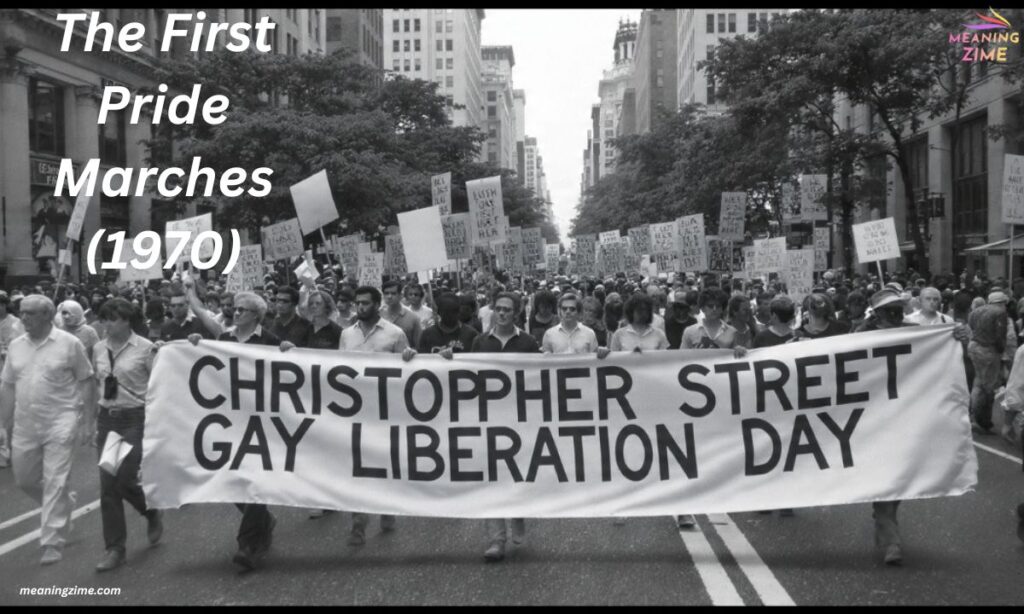
Exactly one year after Stonewall, on June 28, 1970, the first organized Gay Pride marches took place simultaneously in four American cities:
| City | Name of March |
| New York City | Christopher Street Liberation Day March |
| Los Angeles | Christopher Street West |
| San Francisco | Gay Freedom Day Parade |
| Chicago | Gay Liberation March |
These marches were revolutionary. Thousands of people walked openly through major city streets, demanding visibility and rights. They were not polished events with corporate sponsors — they were acts of radical self-affirmation in the face of widespread hostility.
The Christopher Street Liberation Day Committee, organized largely by Brenda Howard (known as the “Mother of Pride”), helped formalize the structure of what would become an annual tradition. Howard advocated for a week-long series of events rather than a single march, which laid the groundwork for the extended celebration model still used today.
The Spread of the Pride Movement Around the World
Through the 1970s and 1980s, Pride celebrations spread beyond the United States as LGBTQ+ communities in other countries were inspired to organize their own marches and events.
- United Kingdom: London held its first Gay Pride Rally in 1972.
- Australia: Sydney’s first Gay Pride march took place in 1978 — an event that would eventually grow into the world-famous Sydney Mardi Gras.
- Canada: Toronto held its first Pride events in 1981.
- Germany: Cologne and other German cities launched Christopher Street Day (CSD) parades in the late 1970s.
- Brazil: São Paulo Pride, which began in 1997, grew into one of the largest Pride parades on Earth, regularly attracting over three million attendees.
By the 1990s, Pride events existed on every inhabited continent.
Official Recognition of Pride Month
United States
In 1999, President Bill Clinton issued the first official U.S. proclamation designating June as “Gay and Lesbian Pride Month.” President Barack Obama expanded this recognition to “Lesbian, Gay, Bisexual, and Transgender Pride Month” in 2009 and renewed the proclamation each year of his presidency.
Under President Joe Biden, the proclamation was again issued annually, with explicit inclusion of transgender and non-binary communities.
International LGBTQ+ Pride Day — June 28
June 28 holds special significance as International LGBTQ+ Pride Day, directly commemorating the date of the 1969 Stonewall Uprising. It is observed globally as a day of remembrance, activism, and solidarity.
Global Government Recognition
Numerous countries and cities have offered varying levels of official recognition to Pride Month or individual Pride events:
- Canada officially recognizes June as Pride Month.
- The United Kingdom, while not designating an official national month, sees broad governmental participation in Pride events.
- France, Ireland, New Zealand, Argentina, and South Africa all host government-supported Pride activities.
How Pride Month Is Celebrated Today
Modern Pride celebrations are among the most diverse cultural events in the world. What began as street protests have evolved into month-long programs that combine commemoration, community building, education, and celebration.
Common Pride Events and Activities
- Pride Parades and Marches: The cornerstone of Pride Month. Major parades in New York, London, São Paulo, Sydney, and Toronto draw millions of participants and spectators.
- Rallies and Speeches: Public gatherings where activists, politicians, and community leaders address ongoing civil rights issues.
- Film Festivals: Events like Frameline (San Francisco) and BFI Flare (London) screen LGBTQ+-themed films.
- Art Exhibitions and Theater: Cultural programming that highlights LGBTQ+ artists and stories.
- Community Fairs and Street Festivals: Local celebrations that bring neighborhoods together.
- Memorials and Vigils: Particularly for communities affected by the AIDS epidemic or anti-LGBTQ+ violence.
- Educational Panels and Workshops: Schools, universities, and community centers host discussions on LGBTQ+ history and rights.
Global Variations in Pride Celebrations
While the rainbow flag unites Pride events worldwide, each country brings its own flavor to the celebration.
| Country | Notable Characteristics |
| Canada | Government-funded events; significant Indigenous LGBTQ+ (Two-Spirit) inclusion |
| France | Paris Pride (Marche des Fiertés) is politically charged, with strong activist roots |
| Ireland | Dublin Pride reflects Ireland’s historic 2015 same-sex marriage referendum victory |
| New Zealand | Auckland Pride embraces Māori and Pacific Islander LGBTQ+ identities |
| Brazil | São Paulo Pride is the world’s largest; deeply intertwined with carnival culture |
| India | Mumbai and Delhi Queer Pride marches grew following the 2018 decriminalization of homosexuality |
In some countries, particularly in Eastern Europe and parts of Asia, Pride events are met with government resistance, counter-protests, or outright bans — underscoring that the struggle for LGBTQ+ rights remains unfinished.
Corporate Participation in Pride Month
Starting in the 1990s, major corporations began participating in and sponsoring Pride events. Today, June brings a wave of rainbow-branded products, social media campaigns, and corporate floats in parades.
Corporate participation has sparked ongoing debate within the LGBTQ+ community:
Arguments in favor:
- Increased visibility and mainstream acceptance
- Financial support for community events and organizations
- Signals to LGBTQ+ employees that their workplace is inclusive
Criticisms:
- “Rainbow washing” — companies that display Pride imagery in June but donate to anti-LGBTQ+ politicians or causes year-round
- Commercialization of a movement rooted in resistance
- Corporate presence can overshadow grassroots activist voices
This tension has led to the rise of alternative Pride events, such as Reclaim Pride marches, which deliberately exclude corporate sponsors and return to the march’s protest roots.
Read also this: What Does LG Mean in Text? Real Meaning, Examples & Social Media Use
Social Media and Modern Pride Celebrations
The digital age transformed how Pride is experienced and shared. Social media platforms have become central to Pride Month in several ways:
- Hashtag campaigns (#Pride, #PrideMonth, #LoveIsLove) amplify visibility globally
- LGBTQ+ creators share personal stories, building community across geographic boundaries
- Activism spreads faster — incidents of discrimination or violence can mobilize responses within hours
- Online Pride events emerged prominently during the COVID-19 pandemic in 2020, when in-person gatherings were impossible
Social media has also exposed Pride to increased political backlash, with coordinated campaigns targeting LGBTQ+ content on certain platforms.
Criticism of Pride Month
Pride is not without its critics, and it is important to engage with those criticisms honestly.
From Within the LGBTQ+ Community
- Some activists argue that modern Pride has become too commercialized and has lost its protest spirit.
- Transgender and non-binary individuals sometimes report feeling underrepresented or tokenized in mainstream Pride events.
- There are ongoing discussions about the centering of white, cisgender gay men’s experiences at the expense of more marginalized groups.
From Conservative and Religious Perspectives
- Some religious communities oppose Pride celebrations on theological grounds.
- Political conservatives in various countries have pushed for restrictions on Pride events, particularly around children’s participation.
- In countries like Russia, Hungary, and several nations in the Middle East and Africa, Pride events face legal bans or violent opposition.
Acknowledging these tensions is part of engaging with Pride honestly — it is not a monolithic, universally accepted event, but a living, contested cultural practice.
Religious and Cultural Perspectives on Pride
Reactions to Pride across religious and cultural contexts vary enormously.
Many religious denominations — including progressive Christian churches, certain Jewish congregations, Unitarian Universalists, and various Buddhist and Hindu communities — actively participate in or affirm Pride Month.
Others, including more conservative branches of Christianity, Islam, and Orthodox Judaism, oppose it on doctrinal grounds while members within those traditions continue to advocate for LGBTQ+ inclusion.
Cultural attitudes also vary. In many Latin American countries, strong Catholic traditions coexist with vibrant Pride celebrations. In Japan, Pride events are largely peaceful and well-attended in major cities, despite the country lacking formal anti-discrimination laws for LGBTQ+ people. In parts of sub-Saharan Africa and Southeast Asia, Pride participants face serious legal risk.
The Importance of Pride Month in Modern Society
Despite — and because of — all this complexity, Pride Month remains profoundly important.
Why Pride Still Matters
- Legal Protections Are Not Universal: In over 60 countries, same-sex relationships remain criminalized. In some, they carry the death penalty.
- Mental Health and Visibility: Research consistently shows that LGBTQ+ youth who feel supported and visible have significantly better mental health outcomes.
- Historical Memory: Pride preserves the memory of figures like Marsha P. Johnson, Harvey Milk, and the Stonewall generation — ensuring their contributions are not forgotten.
- Ongoing Discrimination: Even in countries with legal protections, LGBTQ+ people face discrimination in housing, employment, and healthcare.
- Community and Belonging: For many LGBTQ+ individuals — especially young people in unsupportive environments — Pride events offer one of the few spaces where they feel fully seen and accepted.
Pride Month is simultaneously a celebration of progress, a mourning of those lost, and a demand for the work still to be done.
Educational Importance of Pride History
Teaching Pride history accurately and thoroughly is essential — in schools, in media, and in public discourse. When students learn about the Stonewall Uprising, about Marsha P. Johnson and Sylvia Rivera, about the AIDS crisis and the activists who forced governments to respond, they gain a more complete understanding of American and world history.
Several countries have made strides in this area. California, New Jersey, Colorado, and Illinois in the U.S. have passed laws requiring LGBTQ+-inclusive history education in public schools. The United Kingdom updated its relationships education curriculum to include LGBTQ+ content in 2020.
Advocates argue that inclusive education reduces bullying, supports LGBTQ+ youth, and builds a more empathetic society for everyone.
Conclusion
Pride Month is many things at once — a party, a protest, a memorial, and a demand. It began in the early morning hours of June 28, 1969, when a group of marginalized people refused, at last, to be invisible. In the more than five decades since, it has grown into a global phenomenon touching every continent and countless cultures.
Understanding Pride means understanding not just the rainbow flags and the parades, but the history behind them: the raids, the riots, the activists who gave their lives, and the ordinary people who simply wanted to exist without fear. It means grappling with the tensions between celebration and commercialization, between inclusion and erasure, between progress and the work still undone.
Whatever one’s perspective on Pride, its history is undeniably part of modern history — and its future remains one of the most important ongoing conversations in the world.
Frequently Asked Questions
Why is Pride Month celebrated in June?
June was chosen to commemorate the Stonewall Riots, which took place on June 28, 1969 in New York City — the event widely credited with igniting the modern LGBTQ+ rights movement.
Who started Pride Month?
The first Pride marches in 1970 were organized by multiple activists, including Brenda Howard, Craig Rodwell, and others inspired by the Stonewall Uprising. Transgender activists Marsha P. Johnson and Sylvia Rivera were also central to early Pride activism.
What does the rainbow flag represent?
The rainbow Pride flag was designed by artist Gilbert Baker in 1978. Each color originally represented a different value — life, healing, sunlight, nature, harmony, and spirit — and it became the enduring symbol of LGBTQ+ pride and diversity.
Is Pride Month officially recognized by governments?
Yes, in many countries. The United States, Canada, and numerous other nations officially recognize June as Pride Month. Local and national governments in many countries participate in or support Pride events.
What is “rainbow washing”?
Rainbow washing refers to the practice of companies displaying LGBTQ+ supportive imagery during Pride Month for marketing purposes without substantively supporting LGBTQ+ causes, policies, or employees throughout the rest of the year.
Are Pride events held in every country?
No. While Pride events exist in dozens of countries, they are banned or severely restricted in over 60 nations where same-sex relationships are criminalized. Participants in some countries face serious legal and physical risks for attending.
What is the difference between Pride Day and Pride Month?
International LGBTQ+ Pride Day is observed specifically on June 28, the anniversary of the Stonewall Uprising. Pride Month refers to the broader month-long celebration observed throughout June.
How has Pride Month changed over time?
Pride has evolved from small, protest-focused marches in the early 1970s to large-scale, globally recognized celebrations that now include corporate sponsors, government participation, cultural events, and digital campaigns — while still maintaining its activist roots for many participants.
Why do some people criticize Pride Month?
Criticisms come from multiple directions: some conservatives and religious communities oppose LGBTQ+ visibility on moral grounds; some within the LGBTQ+ community criticize commercialization, exclusion of marginalized groups, or loss of the movement’s protest spirit.
What is the significance of Marsha P. Johnson to Pride?
Marsha P. Johnson was a Black transgender woman and activist present at the Stonewall Uprising who later co-founded STAR, one of the earliest LGBTQ+ advocacy organizations. She is considered a foundational figure in LGBTQ+ liberation history.

I am Olivia, the passionate writer and creator behind MeaningZime, where I share meaningful insights, inspiring ideas, and engaging content about names, quotes, emotions, and life-related topics. I love exploring the deeper meanings hidden in words and turning them into easy-to-understand articles that inform and inspire readers around the world. Through MeaningZime.com, my goal is to create a place where curiosity meets knowledge and every visitor finds something valuable, relatable, and uplifting.

2 thoughts on “Pride Month: Meaning, History and Global Celebration”