

Every June 14, Americans across the country pause to honor one of the most powerful symbols in the world — the Stars and Stripes. Flag Day 2026 falls on Sunday, June 14, making it an especially fitting weekend to reflect on the nation’s founding values, display Old Glory with pride, and participate in community celebrations that have been held for well over a century.
Yet despite its deep historical roots, Flag Day remains one of America’s most underappreciated patriotic observances. Many people couldn’t tell you when it is, let alone why it exists. That’s a problem worth fixing.
This guide covers everything you need to know about Flag Day 2026 — from the 1777 congressional resolution that started it all, to the Wisconsin schoolteacher who spent decades fighting for national recognition, to the parades, ceremonies, and traditions that bring communities together every year on June 14.
What Is Flag Day? Understanding America’s Patriotic Holiday

Flag Day is an annual American observance held each year on June 14. Its central purpose is to commemorate the adoption of the United States flag by the Second Continental Congress on June 14, 1777 — a date that marks the birth of the official Stars and Stripes.
Unlike Independence Day or Memorial Day, Flag Day is not a federal public holiday, which means most Americans don’t get the day off work. However, it is a nationally recognized observance, and since 2026’s Flag Day falls on a Sunday, communities across the country have even more reason to come together for parades, ceremonies, and flag displays.
The holiday serves several important purposes:
- Honoring the flag’s history and the sacrifices made under its banner
- Encouraging civic pride and national unity
- Educating younger generations about American symbols and values
- Observing flag etiquette as outlined in the U.S. Flag Code
At its core, Flag Day is about more than a piece of fabric. The American flag represents freedom, resilience, and the ideals upon which the nation was built. Taking one day each year to acknowledge that meaning is what Flag Day is all about.
Why Is Flag Day Celebrated on June 14?
The answer is straightforward: June 14 is the anniversary of the day the United States officially got its flag.
On June 14, 1777, the Second Continental Congress, meeting in Philadelphia, passed a resolution establishing the design of the new nation’s official flag. That resolution — just the fifth item on the agenda that day — stated that the flag of the thirteen United States would consist of thirteen alternating red and white stripes, with a union of thirteen white stars on a blue field, “representing a new constellation.”
That single sentence changed the visual identity of a nation. From that moment forward, the Stars and Stripes became the official banner of the United States, replacing the earlier Grand Union Flag, which had still incorporated elements of the British Union Jack.
The first major public commemoration of this date took place exactly 100 years later on June 14, 1877, when Congress directed that the American flag be flown from every public building in the country to mark the flag’s centennial. That event planted the seed for what would eventually become the annual Flag Day observance.
The Origin of Flag Day: How the Holiday Began
The journey from a congressional resolution in 1777 to a nationally recognized observance in the modern era was long, gradual, and driven almost entirely by ordinary citizens who believed the flag deserved a day of honor.
Early Advocacy in Schools and Communities
The roots of Flag Day lie in America’s classrooms. In the latter half of the 19th century, several teachers and civic leaders began organizing small ceremonies to honor the flag on June 14. These grassroots efforts were scattered and unofficial, but they reflected a growing belief that the flag — and what it stood for — deserved formal recognition.
The Centennial Moment of 1877
The centennial Flag Day of June 14, 1877 gave the observance its first real national footprint. As instructed by Congress, the flag flew from public buildings coast to coast for the first time in recognition of the flag’s 100th anniversary. For many Americans, seeing the Stars and Stripes raised in unison across the country reinforced the idea that June 14 should be marked every year, not just every century.
Growing Momentum in the Late 1800s
Through the 1880s and 1890s, individual states and cities began holding their own annual Flag Day observances. Organizations like the Betsy Ross House in Philadelphia and various patriotic societies hosted June 14 commemorations, slowly building a tradition that would eventually demand national attention.
Official Recognition: From Wilson to Truman
In 1916, President Woodrow Wilson issued a proclamation officially recognizing June 14 as Flag Day — the first time a sitting U.S. president had formally acknowledged the observance. This was a watershed moment, but it still lacked the force of law.
That changed in August 1949, when President Harry Truman signed legislation passed by Congress officially designating June 14 as National Flag Day. While still not a federal public holiday, the Act of Congress gave Flag Day its permanent, legally recognized place on the American calendar.
Read this: 305+ Anonymous Username Ideas to Feel Truly Hidden 2026
Who Was Bernard J. Cigrand? The Father of Flag Day
No story about Flag Day is complete without Bernard J. Cigrand — the man whose tireless, decades-long campaign transformed a school exercise into a national institution.
Early Life and Teaching Career
Bernard John Cigrand was born on October 1, 1866, in Waubeka, Wisconsin, the son of immigrants from Luxembourg. As a young man, he developed a deep fascination with American history and a reverence for the national flag that would define his life’s work.
In 1885, at just 19 years old, Cigrand was working as a grade school teacher at Stony Hill School in Waubeka, Wisconsin. On June 14 of that year — the 108th anniversary of the flag’s adoption — he placed a small 10-inch, 38-star flag in an inkwell on his classroom desk and asked his students to write essays about what the flag meant to them. He called the day the flag’s “birthday.”
That simple classroom act is now recognized as the first formal observance of Flag Day in American history. Stony Hill School is today listed on the National Register of Historic Places for its connection to this event.
A Life Dedicated to the Flag
Cigrand’s commitment didn’t end with that one classroom exercise. After moving to Chicago to attend dental school, he continued his crusade through writing and public speaking. In June 1886, he published his first major public proposal for an annual flag observance in a piece titled “The Fourteenth of June” in the Chicago Argus newspaper.
Over the following decades, Cigrand:
- Gave more than 2,188 speeches on American patriotism and the flag
- Became editor-in-chief of American Standard, the magazine of the Sons of America
- Served as president of both the American Flag Day Association and the National Flag Day Society
- Eventually became the third dean of what is now the University of Illinois at Chicago College of Dentistry
His persistence paid off on May 30, 1916, when President Woodrow Wilson issued a proclamation formally establishing June 14 as National Flag Day — a goal Cigrand had pursued for over three decades.
Bernard J. Cigrand passed away on May 16, 1932, but his legacy endures. The Chicago Tribune once noted that he had “almost singlehandedly” established the holiday. Today, a bust of Cigrand stands at the National Flag Day Americanism Center in Waubeka, Wisconsin, honoring the man who made sure America never forgot its flag’s birthday.
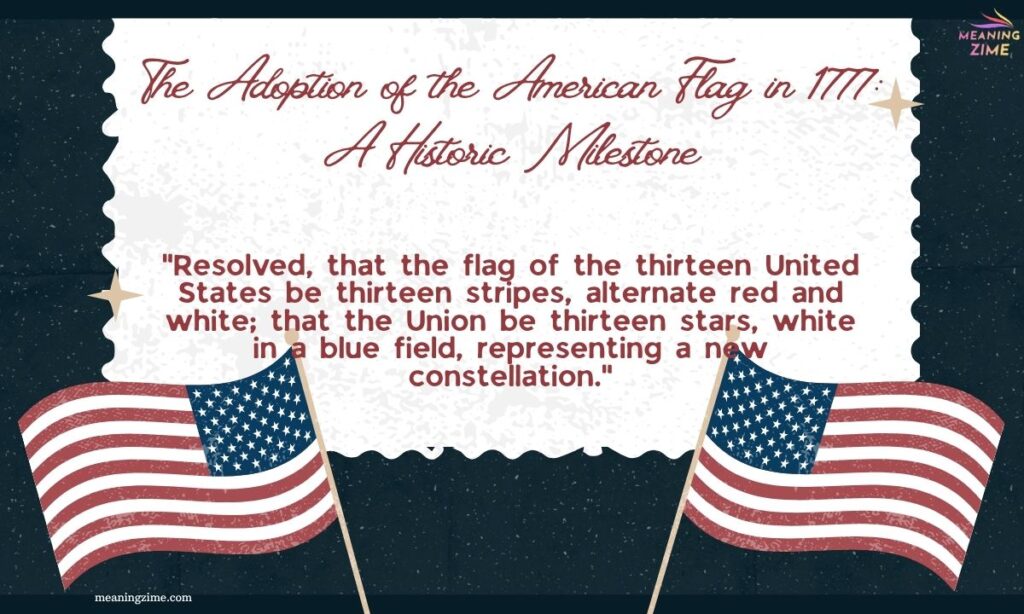
The Adoption of the American Flag in 1777: A Historic Milestone
To understand Flag Day, you need to understand the moment it commemorates — one of the most consequential decisions made during the American Revolution.
The Flag Resolution of June 14, 1777
When the Continental Congress met in Philadelphia in June 1777, the United States was little more than a year old. The Declaration of Independence had been signed in July 1776, but the new nation still lacked a unified national symbol. Different regiments fought under different flags, and the existing Grand Union Flag still incorporated British design elements — an awkward reminder of the colonial past.
On June 14, 1777, the Second Continental Congress passed what became known as the Flag Resolution, which stated:
“Resolved, that the flag of the thirteen United States be thirteen stripes, alternate red and white; that the Union be thirteen stars, white in a blue field, representing a new constellation.”
This resolution officially established the design of the American flag. The language was deliberately symbolic — calling the stars “a new constellation” framed the United States as something genuinely new in the world, not simply a renamed British colony.
What the Stars and Stripes Symbolize
| Element | What It Represents |
| 13 stripes (7 red, 6 white) | The 13 original colonies |
| 50 white stars | The 50 current U.S. states |
| Blue field (canton) | Vigilance, perseverance, and justice |
| Red color | Hardiness and valor |
| White color | Purity and innocence |
Note: The symbolic meanings of red, white, and blue were formally described by Charles Thomson in his 1782 account of the Great Seal — not in the original Flag Resolution itself.
From 13 Stars to 50: The Flag’s Evolution
The flag that flew in 1777 had 13 stars and 13 stripes — one for each of the original colonies. As new states joined the Union, stars were added. The current 50-star flag, which includes Hawaii’s star, has been the official design since July 4, 1960 — making it the longest-serving version of the flag in American history.
The Betsy Ross Question
Popular legend credits Philadelphia seamstress Betsy Ross with designing and sewing the first American flag. Historians, however, have found no conclusive evidence to confirm this claim. What is documented is that Ross did sew flags for the Pennsylvania Navy in 1777 and continued flag-making work for the government throughout her life. Whether she created the very first Stars and Stripes remains one of the great open questions in American history.
When Did Flag Day Become an Official U.S. Observance?

The path to official recognition was a long one, shaped by presidential proclamations and congressional action across nearly two centuries.
| Year | Event |
| 1777 | Continental Congress adopts the Stars and Stripes (June 14) |
| 1877 | First major Flag Day observance — flag flown from public buildings on the centennial |
| 1885 | Bernard Cigrand holds first formal classroom Flag Day in Waubeka, WI |
| 1889 | George Balch organizes Flag Day ceremonies for New York City schoolchildren |
| 1916 | President Woodrow Wilson officially proclaims June 14 as Flag Day |
| 1949 | President Harry Truman signs legislation making June 14 National Flag Day |
| 1966 | Congress requests the President annually proclaim National Flag Week |
It’s worth noting that while August 1949 gave Flag Day its permanent legal standing, it still does not carry the status of a federal holiday like Independence Day or Thanksgiving. Schools, businesses, and government offices generally remain open. However, the President of the United States issues an annual proclamation each year marking the occasion.
National Flag Week: History, Purpose, and Annual Proclamations
Flag Day doesn’t stand alone. Since 1966, Congress has designated the entire week in which June 14 falls as National Flag Week.
Each year, the President issues a formal proclamation calling on citizens to fly the American flag at their homes and businesses throughout the week. The proclamation typically urges Americans to reflect on the flag’s symbolism and on their responsibilities as citizens of a free republic.
National Flag Week 2026 runs from approximately June 8–14, with Flag Day itself — Sunday, June 14 — as the culminating day of observation.
The goals of National Flag Week include:
- Encouraging broader public display of the flag
- Promoting flag etiquette education in schools and communities
- Honoring the military personnel and veterans who have served under the Stars and Stripes
- Strengthening civic awareness and national identity across generations
Many communities use National Flag Week as an opportunity to organize school programs, essay contests, and flag retirement ceremonies — events that extend the spirit of Flag Day beyond a single day.
How Americans Celebrate Flag Day Today
Flag Day may not come with fireworks or a long weekend, but it is observed in meaningful ways across the country. Here is how Americans typically mark the occasion:
Flying the Flag
The most common and fundamental way to observe Flag Day is simply to fly the American flag. The U.S. Flag Code encourages citizens to display the flag at their homes and businesses on June 14. If you leave your flag up after dark, it should be properly illuminated.
Attending Parades and Ceremonies
Communities large and small organize Flag Day parades, color guard presentations, and flag-raising ceremonies. These events often include patriotic music, Pledge of Allegiance recitations, and remarks from local officials or veterans.
Flag Retirement Ceremonies
Flag Day is a traditional occasion for retiring old or worn flags. The proper way to dispose of a flag that is no longer fit for display is through a dignified burning ceremony, often conducted by veterans’ organizations, Boy Scout troops, or civic groups. If your flag is faded, frayed, or torn, Flag Day is the appropriate time to replace it and retire the old one with respect.
School Programs and Civic Education
Many schools hold special Flag Day lessons, essay contests, and assembly programs to teach students about the flag’s history, the Flag Resolution of 1777, and proper flag etiquette. This tradition traces directly back to Bernard Cigrand’s 1885 classroom exercise in Waubeka.
Visiting Historic Sites
For those with a deeper interest in flag history, Flag Day is a great occasion to visit relevant historic sites, including:
- The Betsy Ross House, Philadelphia, PA — hosts special Flag Day programming
- Stony Hill School, Waubeka, WI — birthplace of Flag Day, now a historic site
- The National Flag Day Americanism Center, Waubeka, WI — dedicated to Cigrand’s legacy
- Independence Hall, Philadelphia, PA — site of the Continental Congress
Flag Day Parades, Events, and Traditions Across the Country
Waubeka, Wisconsin — The Birthplace of Flag Day
No place in America has a deeper connection to Flag Day than the small community of Waubeka, Wisconsin. Every year on or around June 14, Waubeka hosts the nation’s longest-running Flag Day parade and a series of community events at the National Flag Day Americanism Center. The center features all 27 star configurations of the U.S. flag throughout history and displays artifacts tracing American history from the Revolution to the present. Visitors come from across the country to experience the holiday at its true birthplace.
Philadelphia, Pennsylvania
Philadelphia holds a special place in Flag Day history. The Betsy Ross House hosts annual Flag Day programs, and the city’s Independence Mall district organizes flag-raising ceremonies, naturalization ceremonies for new citizens, military observances, and family-friendly patriotic events. For Flag Day 2026, Philadelphia’s historic district is expected to host one of the country’s most significant public celebrations.
Troy, New York
Troy has a long tradition of hosting one of the largest Flag Day parades in the northeastern United States, drawing tens of thousands of spectators each year.
Communities Nationwide
Across the country, local American Legion posts, Veterans of Foreign Wars chapters, Rotary Clubs, and civic organizations coordinate:
- Flag retirement ceremonies
- Pledge of Allegiance recitations
- Community flag displays and decoration contests
- Veterans’ recognition events
10 Fascinating Flag Day Facts Every American Should Know
- Flag Day 2026 falls on a Sunday — June 14, 2026 — making it a natural occasion for family and community celebrations without the need for a day off work.
- The U.S. Army shares its birthday with Flag Day. The Continental Congress authorized the enlistment of the first Army regiments on June 14, 1775 — exactly two years before the Flag Resolution. Every year on June 14, the Army celebrates its founding anniversary alongside Flag Day.
- The first Flag Day classroom ceremony used a 10-inch flag placed in an inkwell. Bernard Cigrand’s historic 1885 observance at Stony Hill School was a modest affair — but its impact was anything but small.
- The Flag Resolution of 1777 gave no arrangement for the stars. Congress said the flag should have thirteen white stars on a blue field but never specified how they should be arranged. Early flags varied widely — some had stars in rows, others in a circle. The familiar Betsy Ross circular arrangement was just one of many designs used in the early years.
- The 50-star flag is the longest-lasting U.S. flag design. Since its adoption on July 4, 1960 — after Hawaii’s statehood — the current flag has been in continuous use for over 65 years, outlasting every previous version.
- Flag Day is not a federal holiday. Despite its national recognition, federal offices remain open and workers do not receive a day off. Only Pennsylvania observes it as a state holiday.
- Bernard Cigrand gave over 2,188 speeches on American patriotism before his death in 1932 — an extraordinary lifetime commitment to a cause most people had never heard of when he started.
- The first official flag was flown in battle at Fort Stanwix on August 3, 1777 — just weeks after the Flag Resolution was passed. According to historical accounts, soldiers made the flag by cutting up their own uniforms.
- President Woodrow Wilson proclaimed Flag Day the same year he named the national anthem. In 1916, Wilson also proclaimed “The Star-Spangled Banner” the national anthem — though Congress didn’t make it official until 1931.
- National Flag Week was established in 1966 by a congressional request that the President issue an annual proclamation designating the week including June 14 as a week of patriotic observance.
Conclusion
In an era of political division and social complexity, Flag Day offers something rare and valuable — a moment of shared national reflection that transcends partisan lines. The American flag has flown over battlefields, courthouses, schoolyards, and front porches for 249 years. It has been carried to the Moon, raised at disaster sites, and draped over the caskets of fallen soldiers.
Flag Day 2026 is not just about honoring a piece of cloth. It is about remembering the people who designed it, fought under it, and spent their lives ensuring that future generations would understand what it means. It is about the 19-year-old teacher in a one-room Wisconsin schoolhouse who placed a small flag in an inkwell and sparked a national tradition. It is about the Continental Congress that chose to call thirteen white stars “a new constellation” — a deliberate act of imaginative hope.

I am Olivia, the passionate writer and creator behind MeaningZime, where I share meaningful insights, inspiring ideas, and engaging content about names, quotes, emotions, and life-related topics. I love exploring the deeper meanings hidden in words and turning them into easy-to-understand articles that inform and inspire readers around the world. Through MeaningZime.com, my goal is to create a place where curiosity meets knowledge and every visitor finds something valuable, relatable, and uplifting.

1 thought on “Flag Day 2026: History, Meaning, Facts, Celebrations, and Traditions”